The Arkansas Traveler looms large in the legend and lore of my beloved home state and here’s what I know about this tale!
The Story of the Arkansas Traveler
If you spend any time in Arkansas, you’ve probably heard about the Arkansas Traveler.
He’s more than just a character! The Arkansas Traveler is a legend, a folktale, a story, a famous folk song, a painting and lithograph, and even the name of a minor league baseball team.
The Arkansas Traveler has been around for nearly two centuries, and his story is one of humor, hospitality, and the unique character of early Arkansas.
Here are some more Arkansas legends that you might be interested in reading!
Where the Story Began
Like all old tales, the details of the story change depending on who is telling it. But the Arkansas version of the tale goes back to around the 1840s, when…
According to the traditional story, Sandford “Sandy” Faulkner was traveling through rural Arkansas when he became lost.
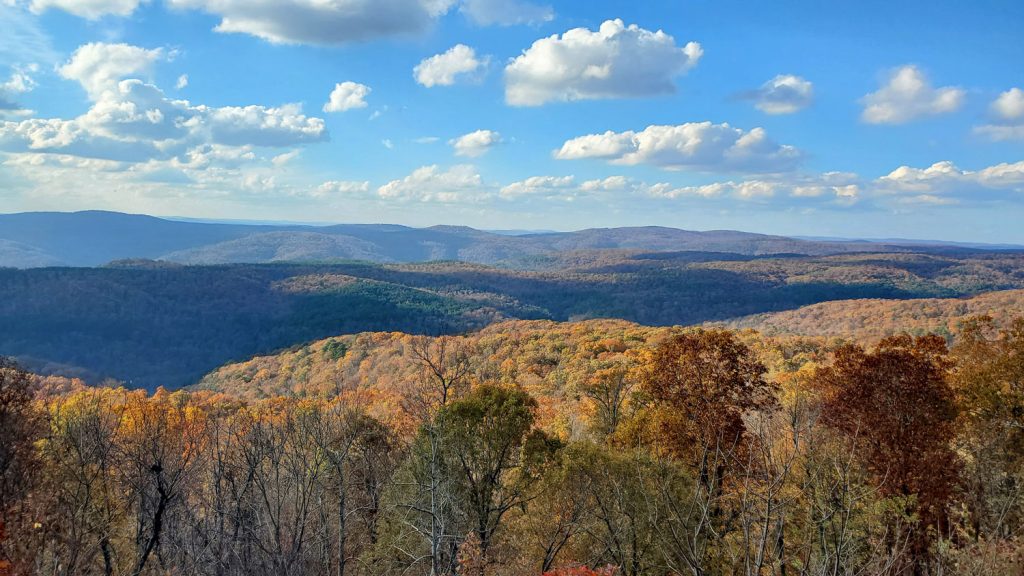
Some versions place the encounter somewhere in the Boston Mountains, part of the Ozarks. If that’s true, I can totally see how he could have gotten turned around. That’s some rugged country.
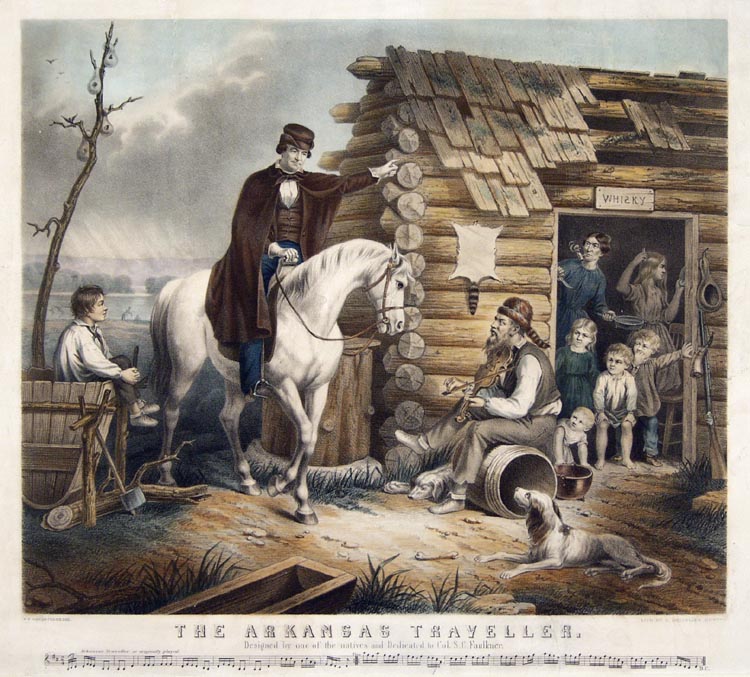
According to the legend as told later by Faulkner himself, he stopped at a shabby-looking cabin to ask for directions. The owner was playing his fiddle on the front porch and wasn’t much interested in helping the outsider out.
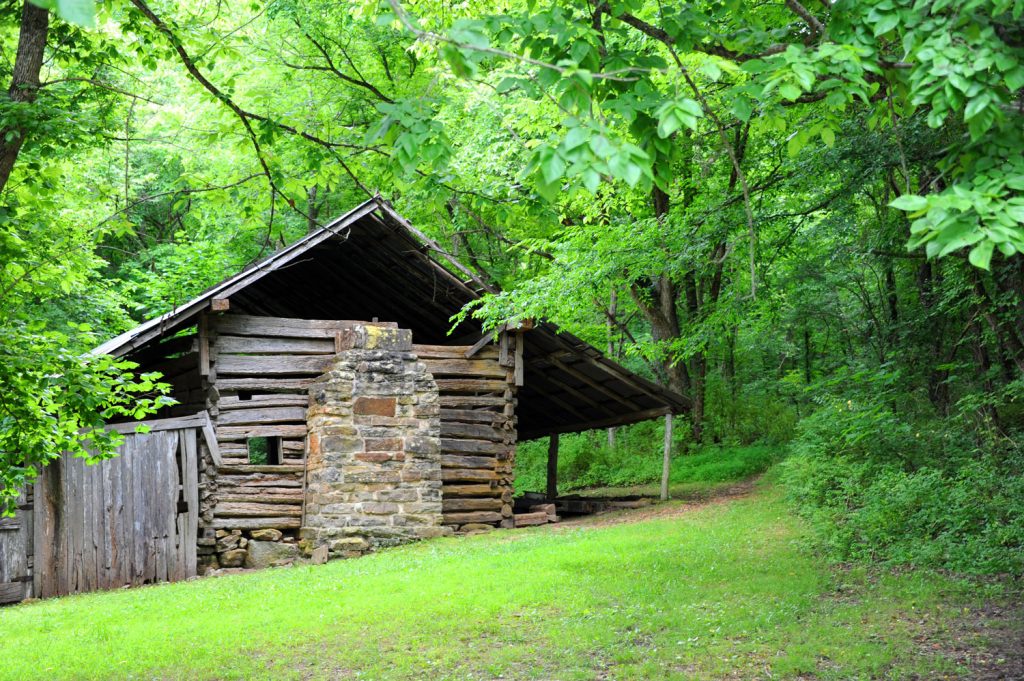
Supposedly Faulkner would ask the settler questions and he would answer in increasingly humorous and evasive ways. However, this particular Arkansas Traveler could also play the fiddle and offered to play along with the mountain man.
At that point the host warmed up and suddenly the Arkansas Traveler had food and drink and a place to rest.
In some versions of this little story it is said that it was raining when the traveler came upon the cabin and the roof was leaking terribly – just pouring buckets into the cabin.
When the owner (or sometimes it is said squatter) was asked why he didn’t fix the roof, he replied that he couldn’t fix it right now because it was raining.
When the traveler suggested he fix it on a nice day the mountain man replied, “well, it doesn’t leak on a nice day!”
The story caught on quickly, although it wasn’t always flattering to Arkansas.
Over time, the Arkansas Traveler helped create the image of Arkansans as rustic backwoods people, a stereotype the state would spend years trying to shake. But the humor, music and eventual show of hospitality also helped the tale endure.

From Story to Song
Music was part of the Arkansas Traveler story almost from the beginning. Sandford Faulkner became known for performing the humorous tale for friends and audiences, complete with fiddle playing.
I’m not exactly sure where the tune came from.
The first known sheet music was published in Cincinnati in 1847 as The Arkansas Traveller and Rackinsac Waltz, arranged by William Cumming. No composer was named, although Faulkner and several others have been credited with writing the tune over the years.
Side Note: Why Rackinsac? Because that was one of the many nicknames of Arkansas over the years.
In 1863, entertainer Mose Case published his own version of the Arkansas Traveler, helping spread the story and music to an even wider audience.
If you’ve ever heard much old-time fiddle music, there’s a good chance you’ve heard this one. It became one of the most recorded tunes in American history.
Later, the tale was performed as a comic sketch on stage, and eventually recorded in the very early days of phonographs. It has now become one of the most recorded tunes in American history.
It became so closely tied to Arkansas that it was eventually named the official state historic song in 1987.
The song is upbeat, lively, and fun much like the story itself.
Here is one version of the song!
The Arkansas Traveler Painting
There is also a famous painting representing The Arkansas Traveler by Arkansas native and artist Edward Payson Washbourne.
Washbourne completed the painting in 1856 and dedicated it to Sandford Faulkner, “Col. S.C. Faulkner.”
In 1859 the original image was published as a lithograph with a few bars of the song and the dedication below. It is made clear that the artist was from Arkansas.
However, In 1870, New York printmakers Currier & Ives brought out popular prints of the “Arkansas Traveller” and they credited neither Faulkner nor Washbourne.
A Symbol of Arkansas
Over time, the Arkansas Traveler became more than just a tune and a painting. He turned into a symbol of the state’s character and culture.
You’ll see his name used all over Arkansas, from businesses and inns to events and even the Little Rock minor league baseball team, the Arkansas Travelers.
In a way, the Arkansas Traveler represents the balance between rugged independence and warm hospitality that still defines the state today.

The “Arkansaw Traveller” Folk Theater
This part of the Arkansas Traveler story is personal for me.
When I was a child, a long, long time ago, my grandparents lived in Hardy, Arkansas, and when we visited in the summer my grandmother would take me to an outdoor theater called the Arkansaw Traveller Folk Theater.
In my memory it was part play, part comedy and part music, and I LOVED it. I remember the Arkansas Traveler coming toward the stage on a real horse, with the stage itself made to look like an old cabin porch.
As I did research for this post I realized that my memory wasn’t playing tricks on me.
The Arkansaw Traveller Folk Theater opened in Hardy in 1968 as a way to preserve and share Ozark music, stories and traditions. The outdoor theater included an authentic log cabin, traditional music, comedy and demonstrations of old Ozark customs.
And, yes, there were animals, including a horse.
The theater became a Hardy attraction for more than two decades before eventually closing in 1990.
I can still picture that place and even better, that memory comes with warm feelings of being with my grandmother.